
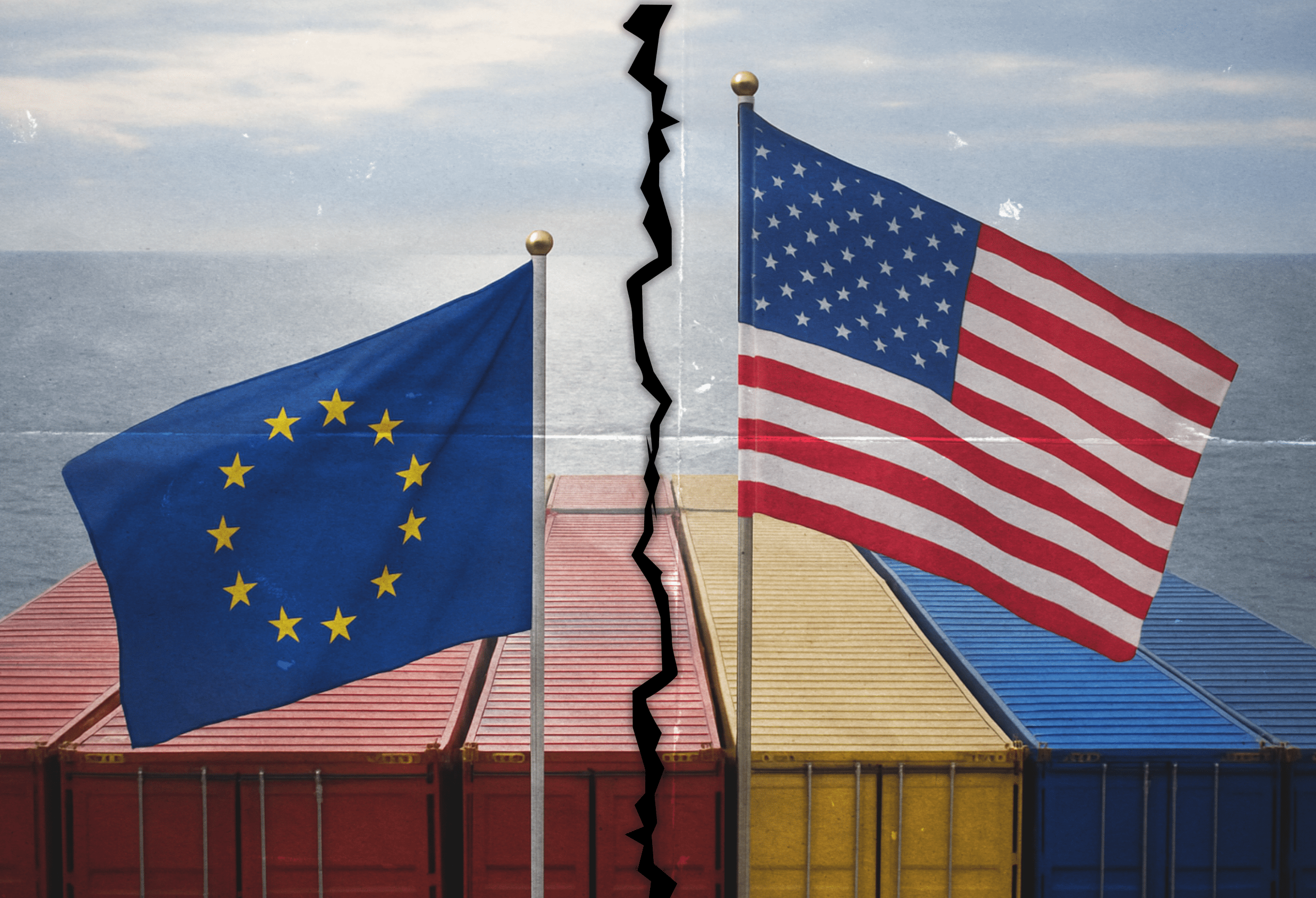
Rethinking EU–US Trade in the Age of Securitisation
Text: Roope Järvinen
Global trade currently sits at a crossroads between integration and protection. While integrated markets have brought significant prosperity, they have also revealed vulnerabilities. Geopolitical shocks and the race to global domination have made governments across the world rethink their trade policy and openness of their markets. Trade is no longer just an economic issue – but equally as much about national security, geopolitics and the protection of critical industries, Roope Järvinen argues in his essay.
The EU and the US are the two largest economies and historical champions of a rules-based trading system. However, even they are not immune to the rising protectionism in the world economy.
“America and Europe have done extraordinary things together before. And I believe we can forge an economic alliance as strong as our diplomatic and security alliances — which, of course, have been the most powerful in history. And, by doing that, we can also strengthen the multilateral trading system.”
With these words in June 2013, US President Barack Obama launched negotiations of the ambitious Transatlantic Trade and Investment Partnership (TTIP) between the EU and the US. TTIP promised millions of jobs, to remove tariffs and to significantly cut regulatory friction. Its logic was straightforward – integrating the world’s two largest economies would benefit both sides of the Atlantic in a way never seen before. The emphasis was on boosting trade and investment and leading with example to strengthen multilateral trade.
But over the next decade the axis has shifted. Trade is no longer about integration and open markets, but rather about threats: how to manage strategic dependence and promote supply-chains that are resilient and reliable, even in times of turmoil. This is the essence of the concept of the securitisation of trade: framing trade policy around strategic risks and resilience, rather than around openness and integration.
With the aim of protecting US national security, in 2018 the then President Donald Trump introduced tariffs on steel and aluminum on allies, including the EU. During his term, President Joe Biden softened this policy slightly, but did not reverse it. New agreements, such as the US’s recent reciprocal trade agreement with Malaysia, speak a similar language of economic security priorities. Likewise, in 2023 the EU launched its Economic Security Strategy to protect the Union’s economy and its citizens from economic dependencies.
These actions suggest that the ambitions of an open market in TTIP have receded. When transatlantic trade a decade ago was focused on how open and integrated markets should be, today the question is how to protect the markets from being weaponised.
Why has transatlantic trade moved from TTIP idealism towards protectionist realism?
While trade integration historically has achieved growth and prosperity, recent geopolitical shocks have exposed vulnerabilities to global disruptions. Reliance on resources, such as the US’s dependence on critical minerals from China, affects American trade policy priorities. Europe has also had to reassess supply chains and strategic dependence, particularly in relation to China.
At the same time, domestic political pressure has forced governments around the world to think about the alternative to open markets. Market dominance has shifted from the West to East, and gains inside the national markets have been unfairly distributed.
This has contributed to shifts in policy preferences toward greater economic nationalism, especially in the US. Both major political parties have increasingly attributed the economic struggles of the American working-class to competition from China. Economic protectionism has become a key bipartisan policy as a response to protect and restore economic opportunity at home.
The idea of global free trade, nor transatlantic free trade, does not seem to hold the same meaning that it once did.
On top of that, the global multilateral and rules-based trading system is becoming less popular by the day. Lawrence L. Herman, a Canadian trade counsel, argues that the WTO’s standing has decreased as a result of technological change and a shattered fate in globalization as well as of the need for consensus which can paralyze decision-making. Herman also notes that Western governments, in their efforts to reduce dependencies, have moved beyond WTO rules while looking to form preferential partnerships with friendly and allied countries.
With the WTO seemingly unable to uphold rules-based global trade, coordinated EU-US leadership toward a multilateral trading order remains difficult.
Where the EU still recognizes the importance of the WTO and a rules-based trading order, in US policy this has become less of a priority. Public support for trade and international organisations has been dissolving among Americans, with regional trading blocks on the rise.
Securitisation of trade has led to new de-risking approaches
The EU is dependent on the US in security, exports and energy. Especially in the area of security, the trade relationship between the two is anything but symmetrical. US Foreign Military Sales to Europe reached a record high $76 billion in 2024, four times the average since 2008.
Security dependence gives the US leverage on the EU in trade, a dynamic that was for example revealed in connection with the recent political agreement on trade and investment reached between EU Commission President Ursula von der Leyen and Trump in July 2025. The deal is generally seen as benefitting the US more than the EU.
Given the EU’s dependence on the US in security as well as exports and energy, the general terms of transatlantic trade will be dictated more in Washington than Brussels.
The securitisation of transatlantic trade, viewed from the US perspective, is best characterised through “friendshoring”, which means moving supply chains to countries considered as economic or political allies, to avoid potential disruptions.
Benefits of the friendshoring policy include greater resilience in a new geopolitical environment and the ability to form broader economic alliances, outside traditional coalitions. Challenges arise in defining who meets the definition of “friend”, in simultaneously advancing international development and growth and in implementing the policy in practice.
The EU’s alternative to friendshoring has been the Open Strategic Autonomy doctrine. While recognising the erosion of multilateralism and geopolitical risks, the Union still wants to be “As Open as Possible, as Autonomous as Necessary”. Von der Leyen has said that the EU wants to de-risk, not decouple from China. De-risking means combatting coercive trade practices by diversifying supply chains. The Union wants to build and maintain a relationship with China that is more balanced and more stable.
In line with the EU’s “de-risking, not decoupling” doctrine, individual EU member states are also joining the securitisation train. Germany for instance, once a staunch supporter of free trade, is now supporting protectionist measures against Chinese steel.
Europeans and Americans agree on the broad need for de-risking, particularly from China. For the EU, this might mean for example strengthening trade and investment with Latin America or Africa.
Unlike de-risking, friendshoring is likely more difficult to implement in practice. Given its selective nature, it raises questions about the criteria behind the choices between friends and enemies.
Regardless of possibly diverging ways to combat the risk posed by China, avoiding a subsidy race between the EU and the US remains a key priority. Subsidies are governmental incentives given to specific industries and companies, which can turn into a race if governments try to outdo each other with ever increasing subsidies.
The future of transatlantic trade relations: competition or cooperation?
It remains to be seen whether US reliance on China for critical minerals will push the EU and US to compete or cooperate. In the EU-US trade deal from July 2025, the EU and US agreed to join forces in order to protect the steel, aluminium and copper sectors from unfair global competition. Managing and protecting the trade of such products is bound to increase economic security on both sides of the Atlantic.
This could be part of a broader trend, where the two identify key areas of cooperation. Proposals to establish a NATO Partnership for Essential Raw Materials raise hopes that this could be a shared goal.
Through cooperation in the EU-US Trade and Technology Council (TTC), a forum for transatlantic cooperation established in 2021, securitisation could be coordinated to a greater extent. The parties have already jointly recognised the need for resilient supply chains, particularly in the area of semiconductors. Still, for the TTC to work it needs to be able to deliver concrete action on both sides, alongside ongoing diplomatic engagement.
Another possible outlook is that the EU focuses more on its trade with another North-American partner, Canada. The comprehensive trade agreement between the EU and Canada, which is almost fully in force, provides a promising foundation, particularly in light of Canada’s access to multiple critical minerals. Further building on this value-based partnership could be a way for the EU to de-risk. The EU might also seek to strengthen partnerships elsewhere in the world, such as the Global South.
If a US-China trade war would erupt, the EU and transatlantic trade would undeniably be caught in the cross-fire. The EU’s approach of “de-risking, not decoupling” would likely put the Union in a difficult position. Keeping in mind the reliance on US security, Washington would most likely dictate the terms more than Brussels.
Transatlantic trade is increasingly shaped by forces outside the control of either the EU or the US. They both recognize the risk posed by dependent supply chains, and their values-based partnership can provide a foundation for increased cooperation in areas where they both need each other, such as critical minerals. When reducing dependencies and hedging against the risk of weaponised supply chains, the multilateral and rules-based trading order may be deprioritized.
The views in this article are the author’s own.
Picture: Elisa Färm
Text editing: Enni Levanen



 English
  Finnish